
Description
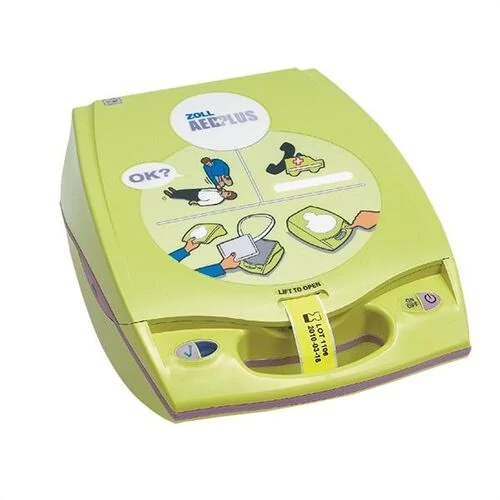
Featuring Real CPR Help (to guide users through CPR) and including rate and depth of chest compressions, these AEDs can see what the user is doing and provide audio and text prompts. In addition, there is a visible bar gauge on their display screens for each compression in real time. And once installed, there is nothing to replace for five years from date of manufacturer—pads and batteries last that long. Units also have ingress protection ratings of IP55 for dust and water, enabling placement outdoors—near water and moisture—or in dusty environments. Powered by ten lithium batteries (included). They also come with CPR-D-padz and a carrying case.
How It Works
• Our one-piece CPR-D-padz®, which contains a pair of electrodes, senses and reports the motion of the chest compressions to the AED Plus.
• Audio and text prompts relay compression quality.
• The compression depth bar gauge lets you see the depth of each compression in real time.
• The adaptive metronome detects compression rate and guides you to at least 100 per minute.
Measuring Chest Compression with Real CPR Help
The force required to depress the chest during CPR varies with the patient’s size and build. The standard
measure of chest compression quality, however, is not force but depth. The Real CPR Help® technology in
ZOLL’s CPR-D-padz® includes a hand-placement locator, an accelerometer, electronics, and a processing
algorithm that work together to measure vertical displacement in space as each compression occurs.
One Size Fits All
ZOLL’s one-piece electrode design accounts for anatomical variation. Based on extensive human data,
CPR-D-padz meet the anthropometric chest characteristics of 99% of the population. If needed, the lower
(apex) electrode can be separated and adjusted to accommodate the remaining 1% of the population.
Simplified Placement
Affixing two separate electrode pads to the patient’s bare chest can be confusing to a lay rescuer.
ZOLL’s CPR-D-padz simplify this step by guiding placement of the red crosshairs at the center of the
imaginary line connecting the patient’s nipples. Once in place, the hand-locator and the two electrode
pads fall naturally into optimal position for both defibrillation and CPR.
Five-Year Shelf Life
All AED electrodes transmit defibrillating electricity into the patient via metal in close contact with
a salt-infused gel that is positioned between the metal and the skin. Over time, however, the salt
in the gel will corrode the metal and eventually compromise electrode functionality. ZOLL’s novel
electrode design includes a sacrificial element that prevents significant corrosion for five years, which
is unmatched in the market today

Reviews
There are no reviews yet.